
Alaska DMV Permit Practice Test 7
Test 7 of 10. Pick an answer for each question to see if it is right and why; your score appears at the end. You need 16 correct answers to pass, the same ratio as the real Alaska test.

- Questions20
- Correct to pass16
- Passing score80%
- Minimum age14 years
-
1. What does a blood alcohol concentration of 0.08 mean for the driver of a car?
Show answer
Answer B: It is the level almost every state treats as legally intoxicated
In almost every state a driver at 0.08 or above is legally intoxicated whatever the driver seems like, but impairment starts well before that level is reached.
-
2. How long can Alaska provisional license restrictions remain in force?
Show answer
Answer B: Up to the driver eighteenth birthday if convictions keep them in place
The provisional stage lasts a minimum of six months but can remain in effect up to the age of 18 when the young driver record does not stay clean.
-
3. How many points does Alaska assign for a conviction of driving while under the influence?
Show answer
Answer D: 10 points
Alaska places driving under the influence in its highest point band at 10 points, the same as reckless driving, refusing a breath sample and eluding a police officer.
-
4. What does it mean to cover the brake, and when should you do it?
Show answer
Answer B: Hold your foot over the brake pedal without pressing it when a hazard seems likely
Covering the brake cuts reaction time when you expect trouble, such as near children, parked cars or a vehicle that may pull out. Riding the brake wears it out and confuses drivers behind you.
-
5. What is the minimum light transmittance Alaska allows for aftermarket tinting on the driver and front passenger windows?
Show answer
Answer C: 70 percent
Alaska allows aftermarket tinting that permits at least 70 percent light transmittance on the driver and front passenger side windows, and at least 40 percent on rear door windows, quarter glasses and back glasses.
-
6. How many points does Alaska assess for leaving the scene of a crash?
Show answer
Answer A: 9 points
Leaving the scene of a crash carries 9 points in Alaska, one step below the 10 point offenses such as reckless driving and DUI.
-
7. How often may an Alaska driver use an approved course to reduce points on the driving record?
Show answer
Answer A: Not more than one course in any 12 month period
Alaska deducts two points for an approved driver improvement or alcohol information course, but no more than one such course may be used for a reduction in any 12 month period.
-
8. What penalty does the Alaska manual give for driving over a fire department hose without permission?
Show answer
Answer C: A 100 dollar fine and 2 points
The Alaska manual lists a 100 dollar fine and 2 points for driving over a fire hose without the consent of a fire department official.
-
9. Under Alaska occupant protection law, for which passengers is the driver legally responsible?
Show answer
Answer D: All passengers under the age of 16
Alaska makes the driver responsible for properly restraining every passenger under 16, using a child safety seat, booster or seat belt as appropriate for the child size.
-
10. This sign is still standing late at night, and nobody is working. What should the driver assume?
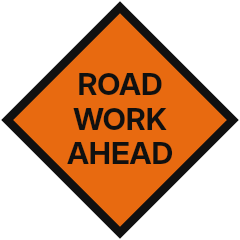
Show answer
Answer B: The layout may still be altered, so the same care and reduced speed apply
Narrowed lanes, shifted alignments, dropped pavement edges and parked equipment remain overnight, so the hazard does not end when the crew goes home.
-
11. Traffic is heavy and a truck is stopped in the lane on your right. How do you keep an out?
Show answer
Answer B: Keep space open ahead of you and avoid being boxed in on both sides at once
Being hemmed in on both sides with no gap ahead removes every option, so keep at least one direction open.
-
12. Why do young drivers carrying several friends face a higher crash risk?
Show answer
Answer D: Because young passengers are a strong source of distraction and pressure
Crash risk for new drivers rises with each extra young passenger, mainly through distraction and social pressure.
-
13. What visual acuity does Alaska require before a license or permit is issued?
Show answer
Answer B: At least 20/40 in each eye or with both eyes together
Alaska requires at least 20/40 vision in each eye or with both eyes together, and a driver who needs corrective lenses to reach the standard must wear them while driving.
-
14. About how much alcohol can the body eliminate per hour?
Show answer
Answer A: About one standard drink
The liver removes alcohol at a nearly fixed rate of roughly one standard drink per hour. Drinking faster than that raises the blood alcohol level, and nothing speeds the process.
-
15. Besides emergency and law enforcement vehicles, which stationary vehicles does the Alaska move over law protect?
Show answer
Answer C: Tow trucks picking up a vehicle, road service and animal control vehicles
Alaska covers a stationary emergency, fire, law enforcement or animal control vehicle, a tow truck in the act of picking up a vehicle, and a vehicle performing maintenance or road service work, when flashing lights are displayed.
-
16. A pedestrian signal changes to a flashing upraised hand. What does that indication mean?
Show answer
Answer C: Do not start crossing, but finish a crossing already begun
The flashing upraised hand is the pedestrian change interval: nobody may start to cross, but a pedestrian already in the crosswalk may continue to the far side or to a median.
-
17. Besides liability cover at the statutory limits, what must an Alaska motor vehicle liability policy provide?
Show answer
Answer C: Uninsured and underinsured motorist coverage in the same amounts
Alaska requires uninsured and underinsured motorist coverage in the same amounts as the liability limits, for the protection of persons insured under the policy.
-
18. The center line beside your lane is solid yellow while the opposite side has a broken yellow line. What does this mean?
Show answer
Answer D: You may not pass, but traffic in the other direction may
A solid yellow line on your side of the center marks a no-passing zone for your direction only, while the broken line grants the opposing direction a passing zone.
-
19. What is the right speed for a normal right turn at a city corner?
Show answer
Answer C: Slow enough to hold your lane and stop for a pedestrian
A city right turn is tight and crosses a crosswalk, so the correct speed is one that keeps you inside your lane and still allows a stop.
-
20. What is special about a traffic offense committed inside an Alaska designated traffic safety corridor?
Show answer
Answer B: The fines are doubled
Alaska designates certain highway sections as traffic safety corridors, and fines for traffic offenses committed within them are doubled.