
Alaska DMV Permit Practice Test 2
Test 2 of 10. Pick an answer for each question to see if it is right and why; your score appears at the end. You need 16 correct answers to pass, the same ratio as the real Alaska test.

- Questions20
- Correct to pass16
- Passing score80%
- Minimum age14 years
-
1. How soon must an Alaska license holder notify the Division of Motor Vehicles of a change of name or address?
Show answer
Answer A: Within 30 days, in writing
Alaska requires written notice to the DMV within 30 days of a change of name or address, with court ordered documentation or a certified marriage certificate for a name change.
-
2. When is a child ready to use a vehicle seat belt without a booster seat?
Show answer
Answer A: When the lap belt lies across the upper thighs and the shoulder belt crosses the chest
Belt fit, not age, decides readiness. Until the child is tall enough for the lap belt to sit on the thighs and the shoulder belt on the chest, a booster is needed.
-
3. Why are drivers required to turn the front wheels when parking on a grade?
Show answer
Answer A: So that a vehicle that starts to roll leaves the traffic lanes instead of entering them
The wheel position is a last line of defense if the parking brake or transmission fails, directing the vehicle into the curb or off the roadway.
-
4. Who may supervise an Alaska instruction permit holder practising in a passenger vehicle?
Show answer
Answer D: A licensed driver at least 21 years old with at least one year of experience in that class of vehicle, seated beside the learner
Alaska requires the supervising driver to be at least 21, to hold at least one year of driving experience in the same type or class of vehicle, and to occupy the seat beside the learner.
-
5. For how long must an ignition interlock device be installed after a third Alaska DUI or refusal conviction?
Show answer
Answer C: 18 months
The Alaska interlock schedule runs 6 months for a first conviction, 12 months for a second, 18 for a third, 24 for a fourth and 30 for a fifth.
-
6. On a street with parking along the curb, the shared lane marking is painted well out from the curb face. What does that placement tell a bicyclist?
Show answer
Answer C: To ride clear of the doors of parked cars
The marking is set at least eleven feet from the curb where parking is allowed so that riders are guided outside the reach of an opening door.
-
7. Besides holding a permit and logging driving hours, what must an Alaska applicant show to receive a provisional license?
Show answer
Answer A: No traffic law conviction in the six months before the application
Alaska requires the provisional applicant to have held a permit for six months, to show 40 hours of certified driving experience, and to have no traffic law conviction in the six months before the application is filed.
-
8. A loaded truck is coming up an entrance ramp as you approach in the right lane of the freeway. What is the most helpful action?
Show answer
Answer A: Adjust your speed to open a gap for it
A heavy vehicle accelerates slowly, so opening a gap or moving over costs you seconds and saves the truck driver from being forced to stop on the ramp.
-
9. What is the unposted maximum speed in an Alaska business district?
Show answer
Answer A: 20 mph
Alaska sets the maximum lawful speed in a business district at 20 mph unless a different limit is posted.
-
10. Which speeding conduct carries 6 points in Alaska?
Show answer
Answer C: 20 mph or more over the limit, or speeding in a school crosswalk
Alaska assesses 6 points both for exceeding the limit by 20 mph or more and for speeding in a school zone or playground crosswalk.
-
11. Under the Alaska Financial Responsibility law, what follows when there is a reasonable possibility that a driver may be found liable in a civil court after a crash?
Show answer
Answer B: The privilege to drive may be suspended for up to three years
Alaska may suspend the driving privilege for up to three years when there is a reasonable possibility of civil liability, and the suspension can be ended at any time by making a financial settlement with the other parties.
-
12. Under Alaska law, what must a slow driver do when five or more vehicles have formed a line behind?
Show answer
Answer A: Pull off the roadway at the first safe opportunity to let them pass
Alaska requires a driver traveling below the speed limit to pull off the roadway at the first safe opportunity when five or more vehicles are queued behind.
-
13. How does an Alaska driver earn a two point deduction from an assessed point total?
Show answer
Answer D: By going 12 months from the last violation without another conviction
Two points are deducted when a licensee goes 12 months after the date of the last violation without another traffic conviction, and two more for an approved driver improvement or alcohol information course.
-
14. What must an Alaska court impose on a driver convicted of DUI for the second time?
Show answer
Answer A: 20 days in jail, a 3,000 dollar fine and 12 months of interlock
A second DUI conviction in Alaska carries a minimum of 20 days imprisonment, a fine of at least 3,000 dollars, and an ignition interlock device for at least 12 months.
-
15. You have turned right into the nearest lane but you need the left lane soon. When should you move over?
Show answer
Answer A: After the turn is finished, once you have checked mirrors and blind spot
Complete the turn in the proper lane first, then make a normal lane change with mirror and blind spot checks once you are established on the new street.
-
16. The gates at a railroad crossing begin to come down as you approach. What must you do?
Show answer
Answer A: Stop and wait until the gates are fully raised and the lights stop flashing
Once the gates start down you must stop clear of the tracks and wait until they are fully raised and the warning lights have stopped.
-
17. On a wet road, how should a driver adjust after passing this sign?
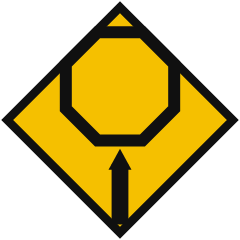
Show answer
Answer B: Start braking earlier, because a slippery surface lengthens the stopping distance
A wet surface lengthens stopping distance, so the extra warning distance should be spent braking gently and early instead of late and hard.
-
18. You are turning left from a one-way street onto another one-way street. Which lane should you use?
Show answer
Answer B: Turn from the far left lane into the far left lane of the new street
The general turning rule is to turn from the lane nearest the direction of the turn into the nearest lane of the new roadway, which on a one-way to one-way left turn means far left to far left.
-
19. What may an Alaska municipality do about the use of cellular telephones by drivers?
Show answer
Answer B: Ban their use on school property or in an active school zone
Alaska allows a municipality to prohibit cellular telephone use by drivers on school property or in an active school zone, but such an ordinance may not prohibit hands-free use.
-
20. A sign warns that your exit leaves from the left side of the freeway. What should you do?
Show answer
Answer D: Move into the left lane in good time before you reach the exit
Left-hand exits are unusual, which is exactly why they are signed well in advance and why the lane changes should be finished early.