
Alaska DMV Permit Practice Test 1
Test 1 of 10. Pick an answer for each question to see if it is right and why; your score appears at the end. You need 16 correct answers to pass, the same ratio as the real Alaska test.
- Questions20
- Correct to pass16
- Passing score80%
- Minimum age14 years
-
1. What happens to an Alaska driving record when the rider of a bicycle is convicted of a traffic violation?
Show answer
Answer A: No points are assessed for a violation committed on a bicycle
Alaska law provides that no points are assessed for traffic violations committed while using a bicycle, although cyclists must still obey the rules of the road.
-
2. What point totals require an Alaska provisional license holder to complete a driver improvement course?
Show answer
Answer C: 6 or more points in 12 months, or 9 or more points in 24 months
Alaska applies a stricter point trigger to provisional license holders, who must complete a driver improvement course at 6 points in 12 months or 9 points in 24 months.
-
3. In which vehicle may a passenger lawfully hold an open alcoholic beverage under Alaska law?
Show answer
Answer A: A vehicle for hire with a capacity of 12 or more persons
Alaska allows a passenger to hold an open container in a motor vehicle for which the owner receives direct monetary compensation and that has a capacity of 12 or more persons.
-
4. On an Alaska four-lane road, what must you do when you encounter a stationary emergency vehicle or tow truck with overhead flashing lights?
Show answer
Answer C: Pull into the lane away from it if it is safe to do so, and otherwise slow to a reasonable and prudent speed
Alaska requires drivers on a four-lane road to move into the lane away from the stopped emergency vehicle or tow truck when it is safe, and to slow to a reasonable and prudent speed when moving over is not possible.
-
5. As speed rises, which part of the total stopping distance grows the fastest?
Show answer
Answer B: The braking distance, which grows far faster than speed itself
Perception and reaction distances grow in step with speed, but braking distance grows roughly with the square of speed, so it dominates at higher speeds.
-
6. A steady green arrow pointing left is displayed for your turning lane. What does it tell you?
Show answer
Answer D: The turn is protected because conflicting traffic is being held
A steady green arrow gives a protected movement in the direction shown, although you still yield to pedestrians and to any vehicle already inside the intersection.
-
7. How far back does Alaska look at prior DUI or refusal convictions when setting an administrative revocation period?
Show answer
Answer B: 15 years
Prior convictions of DUI or refusal in Alaska or another state within the last 15 years can be used to determine the length of the administrative revocation.
-
8. Who must take the Alaska written knowledge test?
Show answer
Answer D: Applicants not currently licensed in Alaska, expired over a year, or revoked
Alaska requires the written test from applicants who are not currently licensed in the state, whose privileges have been expired for over one year, or whose privileges have been revoked.
-
9. What offense does Alaska charge when driving while texting causes the death of another person?
Show answer
Answer D: A class A felony
Alaska grades the offense by the harm caused: a class C felony for physical injury, a class B felony for serious physical injury, and a class A felony when the driving causes a death.
-
10. What relief is available to an Alaska driver whose license is suspended for accumulating points?
Show answer
Answer D: None, because no limited work purpose license is available
Alaska states that no limited work purpose license is available when a suspension or revocation is required by point accumulation, regardless of the hardship involved.
-
11. Besides motorist services and tourist information, a blue sign background is also used for
Show answer
Answer B: evacuation route signing
Blue is assigned to road user services, tourist information and evacuation routes, so hurricane and other evacuation routes are signed in blue.
-
12. You make eye contact with a driver waiting to pull out of a side street. What should you assume?
Show answer
Answer D: The driver may still not have seen you, so stay ready to slow or stop
Drivers can look directly at you and still not register your vehicle, especially a small one. Eye contact helps, but never rely on it.
-
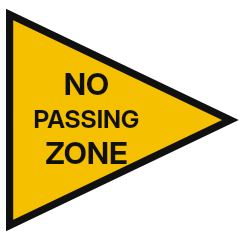
13. Why would a restriction like this one be applied to a stretch of road?
Show answer
Answer A: Because there is not enough visible road ahead to complete a pass safely
Limits on overtaking are set where a hill, a curve or an obstruction leaves too little sight distance for a driver to pull out, pass and return before meeting oncoming traffic.
-
14. A sign warns that the right lane ends ahead, and traffic is still flowing freely. What should you do if you are in that lane?
Show answer
Answer C: Signal, adjust your speed and move left in good time before the lane ends
When traffic is moving freely there is room to merge early and smoothly, which avoids the last-second lane change at the closure point.
-
15. When must an Alaska driver give immediate notice of a crash to the police or the Alaska State Troopers?
Show answer
Answer B: When there is injury or death, or damage of 2,000 dollars or more
Alaska requires immediate notice by the quickest means when a crash results in bodily injury or death, or in total property damage to an apparent extent of 2,000 dollars or more.
-
16. What does the implied consent law mean for drivers?
Show answer
Answer D: By driving, you have agreed to a chemical test if lawfully arrested for impaired driving
Holding a license and driving on public roads is treated as consent to breath, blood or urine testing when an officer has grounds to arrest you. Refusing normally brings its own license penalties.
-
17. What is the purpose of the SR-22 filing that an Alaska driver must make after a license action?
Show answer
Answer D: It makes the insurer tell the DMV if the coverage lapses
Alaska requires proof of financial responsibility for the future after a suspension, revocation or limitation, usually through an SR-22 filing that obliges the insurance company to notify the DMV of any lapse or cancellation.
-
18. Which Alaska child must be secured in a booster seat rather than in a seat belt alone?
Show answer
Answer C: One over 4 and under 8, below 57 inches and 20 to 65 pounds
Alaska requires a booster seat for a child over four but under eight years of age who is less than 57 inches tall and weighs 20 pounds or more but less than 65 pounds.
-
19. Once you have parallel parked, how close to the curb should your wheels be?
Show answer
Answer C: Within the distance your state allows, commonly 12 to 18 inches
Parking close to and parallel with the curb keeps the vehicle out of the traffic lane without damaging the tires; each state sets the exact maximum, usually 12 inches and 18 inches in some states.
-
20. You park in your own driveway and the rear of the vehicle sticks out over the sidewalk. What is wrong with that?
Show answer
Answer C: It blocks the sidewalk and forces people into the street
A vehicle overhanging the sidewalk pushes pedestrians, wheelchair users and strollers into the roadway, and blocking a sidewalk is prohibited.