
Alaska DMV Motorcycle Practice Test 4
Test 4 of 6. Pick an answer for each question to see if it is right and why; your score appears at the end. You need 20 correct answers to pass, the same ratio as the real Alaska test.
- Questions25
- Correct to pass20
- Passing score80%
- Minimum age16 years
-
1. You are approaching a marked school crossing and children have started to cross the roadway. What is required?
Show answer
Answer A: Stop and let the children finish crossing the roadway
Drivers give way to people in a marked crossing, stopping if that is what it takes, and children in particular may change direction without warning.
-
2. Besides liability cover at the statutory limits, what must an Alaska motor vehicle liability policy provide?
Show answer
Answer C: Uninsured and underinsured motorist coverage in the same amounts
Alaska requires uninsured and underinsured motorist coverage in the same amounts as the liability limits, for the protection of persons insured under the policy.
-
3. On an Alaska four-lane road, what must you do when you encounter a stationary emergency vehicle or tow truck with overhead flashing lights?
Show answer
Answer C: Pull into the lane away from it if it is safe to do so, and otherwise slow to a reasonable and prudent speed
Alaska requires drivers on a four-lane road to move into the lane away from the stopped emergency vehicle or tow truck when it is safe, and to slow to a reasonable and prudent speed when moving over is not possible.
-
4. How does an Alaska driver earn a two point deduction from an assessed point total?
Show answer
Answer D: By going 12 months from the last violation without another conviction
Two points are deducted when a licensee goes 12 months after the date of the last violation without another traffic conviction, and two more for an approved driver improvement or alcohol information course.
-
5. About how far behind a tractor-trailer does the driver's rear blind spot reach?
Show answer
Answer C: Around 30 feet
The area behind a large truck is hidden for roughly 30 feet, so a driver tucked in there cannot be seen at all.
-
6. Which speeding conduct carries 6 points in Alaska?
Show answer
Answer C: 20 mph or more over the limit, or speeding in a school crosswalk
Alaska assesses 6 points both for exceeding the limit by 20 mph or more and for speeding in a school zone or playground crosswalk.
-
7. What is the unposted maximum speed in an Alaska business district?
Show answer
Answer A: 20 mph
Alaska sets the maximum lawful speed in a business district at 20 mph unless a different limit is posted.
-
8. What speed does the Alaska manual give for a school zone that is not otherwise posted?
Show answer
Answer B: 20 mph
The Alaska manual lists 20 mph as the maximum for a school zone under favorable conditions on a road that is not otherwise posted.
-
9. An overhead lane-use control signal shows a steady red X above your lane. What does it mean?
Show answer
Answer B: You may not use that lane and must move out of it
A steady red X means the lane below it is closed to you, while a steady yellow X is the warning to prepare to vacate the lane and a downward green arrow means the lane is open.
-
10. What penalty does the Alaska manual give for driving over a fire department hose without permission?
Show answer
Answer C: A 100 dollar fine and 2 points
The Alaska manual lists a 100 dollar fine and 2 points for driving over a fire hose without the consent of a fire department official.
-
11. How many points does Alaska assign for a conviction of driving while under the influence?
Show answer
Answer D: 10 points
Alaska places driving under the influence in its highest point band at 10 points, the same as reckless driving, refusing a breath sample and eluding a police officer.
-
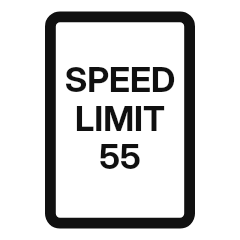
12. A driver passes this sign on an open road. Over what stretch does the figure it sets stay in force?
Show answer
Answer A: From the sign onward, in every lane, until another sign sets a different figure
The figure governs the road from the sign onward and binds every lane, and it stays in force until a later sign sets a different one.
-
13. Which combination best reduces the chance of hydroplaning?
Show answer
Answer D: Good tread depth, correct tire pressure and lower speed in the rain
Tread channels water away, correct pressure keeps the tire's shape, and lower speed gives the tire time to push water aside. Hydroplaning can begin at surprisingly modest speeds.
-
14. Two people drink the same amount of alcohol at the same time. Why might their blood alcohol concentrations differ?
Show answer
Answer C: Body weight, gender and food in the stomach affect the concentration
Smaller people and, on average, women reach higher concentrations from the same amount of alcohol, and an empty stomach speeds absorption. Counting drinks alone does not tell you your level.
-
15. You are passing a crash on the other side of a divided highway. What should you do?
Show answer
Answer D: Keep your eyes on your own lane and the traffic around you
Staring at a crash scene, often called rubbernecking, causes sudden slowing and secondary collisions. Your attention belongs on the traffic in front of you.
-
16. What is the danger of releasing the brake too early when moving off uphill?
Show answer
Answer C: The motorcycle rolls backward before the clutch has taken hold
On a grade the brake has to stay on until the engine is actually pulling, otherwise the machine runs back into whatever is behind it.
-
17. What is the role of the sweep rider in a group?
Show answer
Answer B: To ride last, watch the group, and notice when a rider drops back or has trouble
The sweep rider takes the last position so that any rider who slows, stops or has a problem is noticed instead of being left behind.
-
18. This sign comes into view ahead of a driver who has already started along a ramp. What should the driver do?

Show answer
Answer B: Pull clear where it is safe, then turn around and leave the ramp traveling properly
The driver is traveling against the legal flow, so the safest response is to stop clear of the lanes, turn the vehicle around and get off the ramp before meeting traffic head on.
-
19. How soon must an Alaska license holder notify the Division of Motor Vehicles of a change of name or address?
Show answer
Answer A: Within 30 days, in writing
Alaska requires written notice to the DMV within 30 days of a change of name or address, with court ordered documentation or a certified marriage certificate for a name change.
-
20. Smoke and flames appear from the engine compartment after you stop. What should you do?
Show answer
Answer A: Get everyone well away from the vehicle first, and then call the fire service
A vehicle fire can spread within seconds, so people come out first and firefighting is left to the fire service.
-
21. How long is the Alaska administrative revocation for a first offense of a minor operating a motor vehicle after consuming alcohol?
Show answer
Answer D: 30 days
Alaska revokes for 30 days on a first offense, 60 days after one previous revocation, 90 days after two, and one year after three or more.
-
22. In normal operation, which indication always comes between a green and a red on the same signal face?
Show answer
Answer C: A steady yellow
The yellow change interval must follow every green or green arrow, so a signal can never jump straight from green to red.
-
23. South of 60 degrees North latitude in Alaska, studded tires may not be used on a paved road during which period?
Show answer
Answer D: April 15 through September 30
South of 60 degrees North the prohibition runs from April 15 through September 30, which is a longer ban than the one applying in the northern part of the state.
-
24. What is the minimum legal tire tread depth in Alaska?
Show answer
Answer B: Two thirty-seconds of an inch
Alaska regulation forbids driving a vehicle with a tire whose tread depth is less than two thirty-seconds of an inch, measured in two adjacent grooves at three points around the tire.
-
25. North of 60 degrees North latitude in Alaska, studded tires may not be used on a paved road during which period?
Show answer
Answer B: May 1 through September 15
Alaska prohibits studded tires and tire chains on paved roads from May 1 through September 15 north of 60 degrees North latitude, and from April 15 through September 30 south of it.