
Alaska DMV Motorcycle Practice Test 35
- Questions25
- Correct to pass20
- Passing score80%
- Minimum age16 years
-
1. You have dropped some distance behind the rest of your group. What should you do?
Show answer
Answer C: Keep your own safe pace, because the group should slow to bring you back
Chasing the group means riding beyond a comfortable pace, so the responsibility sits with the leader to slow down until the formation is whole again.
-
2. While you swerve around an obstacle, what should the rest of your body be doing?
Show answer
Answer C: Staying upright with the knees against the tank while the motorcycle leans
A swerve happens through the handlebars, and a body that stays still and anchored to the tank lets the motorcycle move quickly beneath the rider.
-
3. What is a microsleep?
Show answer
Answer D: A few seconds of sleep, sometimes with the eyes open
A microsleep is an involuntary lapse of a few seconds during which the driver is asleep and the vehicle travels blind, often without the driver knowing.
-
4. What should riders expect from highway traffic when a group is merging?
Show answer
Answer C: Drivers will not hold a gap open for the group, so riders take real gaps
Other drivers do not treat a line of motorcycles as one vehicle, so each rider has to find a genuine gap rather than count on being let in.
-
5. You are waiting to pull out of a driveway when a bicyclist comes along the bike lane in front of you. What must you do?
Show answer
Answer D: Wait until the bicyclist has gone past
A driver leaving a driveway yields to everything already on the road, and a bike lane is part of the roadway.
-
6. What does a yield sign require of a driver?
Show answer
Answer A: Slow down, and stop when necessary, so conflicting traffic can go first
A yield sign obliges the driver to reduce to a speed suited to conditions and to stop when needed so that conflicting traffic or pedestrians are not interfered with.
-
7. In T-CLOCS, what does the letter O stand for?
Show answer
Answer B: Oil and other fluid levels
The O step covers engine oil, along with coolant, hydraulic brake fluid and any final drive fluid, plus a look underneath for leaks.
-
8. You must leave your vehicle beside a narrow rural road at night. What should you do?
Show answer
Answer B: Get it right off the pavement and switch on the hazard lights
A vehicle left on an unlit rural road is very hard to see, so move it completely clear of the traveled surface and mark it with the hazard lights.
-
9. Cannabis is legal for adults in some states. What does that mean for driving?
Show answer
Answer C: Driving while impaired by it is still an offense
Legal possession has nothing to do with driving law, and every state treats driving while impaired by cannabis as an offense.
-
10. You and an oncoming driver are both turning left at the same intersection. What is the usual rule?
Show answer
Answer D: Both turn in front of each other unless markings show otherwise
The normal practice is to pass driver side to driver side, turning in front of one another, unless pavement markings or signs direct a different path.
-
11. What actually lowers the amount of alcohol in a person's blood?
Show answer
Answer D: The passage of time
The body eliminates alcohol at its own steady rate, so only time reduces blood alcohol. Coffee or a cold shower may make a person feel more awake while still impaired.
-
12. You are about to pull out from a stop sign. Which scanning habit is correct?
Show answer
Answer A: Look to the left, then to the right, then to the left again before moving
Traffic from the left reaches you first, and a second look left catches anything that arrived while you were looking right.
-
13. On a long uphill grade a second lane opens on the right and a sign directs slower traffic into it. You are towing a trailer and holding up a line of vehicles. What should you do?
Show answer
Answer A: Move into the right-hand lane and let the faster traffic use the left lane
A climbing lane exists so that slow vehicles can be passed safely, and the slower vehicle is the one that belongs in it.
-
14. On a motorcycle with a standard shift pattern, where is neutral found?
Show answer
Answer C: Between first gear and second gear
The usual pattern is one down and the rest up, with neutral sitting half a click between first and second gear.
-
15. What kind of sole and heel suit motorcycle boots?
Show answer
Answer A: A hard, slip resistant sole with a low heel that will not catch
Boots have to grip the pavement when you put a foot down and grip the footrests while you ride, and a tall heel can catch on the ground or on the machine.
-
16. In most states, how far before a turn must your signal already be on in city traffic?
Show answer
Answer B: At least 100 feet, roughly the length of six or seven cars
Most states require the signal for at least 100 feet before a turn in city driving, which gives drivers behind you time to react before you slow; several require more at higher speeds.
-
17. What minimum jail sentence does Alaska attach to driving while a license is canceled, suspended or revoked?
Show answer
Answer A: Not less than 10 days
Alaska sets a minimum sentence of not less than 10 days imprisonment for driving while the license is canceled, suspended or revoked, or in violation of a limited license.
-
18. When must a passenger keep both feet on the footrests?
Show answer
Answer C: At all times, including while the motorcycle is stopped
Feet stay on the footrests even at a stop, because a foot put down or swung out can unbalance the motorcycle or be caught by the road.
-
19. Alcohol is classified as which kind of drug?
Show answer
Answer B: A depressant that slows the central nervous system
As a depressant, alcohol slows the brain and nervous system, which lengthens reaction time and dulls the coordination that driving depends on.
-
20. A school crossing guard steps into the roadway and holds up a stop paddle. What must you do?
Show answer
Answer D: Stop and stay stopped until the guard and the children have left the road
A crossing guard directs traffic with legal authority; you must remain stopped until both the guard and the children are clear of the roadway.
-
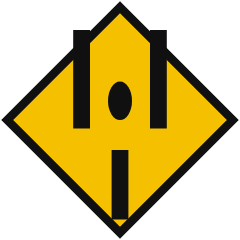
21. Beyond the point this sign refers to, which movement becomes unlawful?
Show answer
Answer D: Driving on the far side of the separation, against the flow
Once the two directions are separated, each roadway carries one-way traffic, so crossing to the other side means driving into oncoming vehicles.
-
22. When should a rider add a layer on a ride that is turning cold?
Show answer
Answer D: Before you start to feel cold, at the next convenient stop
Once a rider is chilled it takes a long time to warm up again, and cold hands and slowed reactions cost control, so add layers before the cold takes hold.
-
23. Why should a rider reduce speed at night even on a familiar road?
Show answer
Answer C: So the stopping distance stays inside the distance the headlight lights up
At night you can only react to what the headlight shows, so keep your speed low enough that you can stop within the lit distance ahead.
-
24. How do stimulant drugs such as amphetamines or cocaine typically affect driving?
Show answer
Answer D: They can make the driver overconfident and more willing to take risks
Stimulants create a false sense of alertness and encourage aggressive, risky driving. When they wear off, sudden fatigue can follow.
-
25. Two people drink the same amount of alcohol at the same time. Why might their blood alcohol concentrations differ?
Show answer
Answer C: Body weight, gender and food in the stomach affect the concentration
Smaller people and, on average, women reach higher concentrations from the same amount of alcohol, and an empty stomach speeds absorption. Counting drinks alone does not tell you your level.