
Alaska DMV Motorcycle Practice Test 34
- Questions25
- Correct to pass20
- Passing score80%
- Minimum age16 years
-
1. Two lanes at the corner are marked for right turns. What does that require of you?
Show answer
Answer A: Keep your own lane through the turn and into the matching new lane
Dual turn lanes work only if each vehicle stays in its own lane all the way round and finishes in the corresponding lane of the new street.
-
2. What is the first riding effect of becoming dehydrated on a hot day?
Show answer
Answer D: Concentration and judgment fade before the rider feels very thirsty
Thirst lags behind fluid loss, so a rider can lose concentration and coordination before feeling thirsty. Drink regularly on hot rides rather than waiting.
-
3. Besides fitting the machine, what else must a passenger be capable of?
Show answer
Answer B: Following the rider's instructions throughout the ride
Instructions such as staying still, holding on and not getting off until told are what keep the pair balanced, and a passenger who cannot follow them is unsafe.
-
4. What is the purpose of carrying a first aid kit in your vehicle?
Show answer
Answer D: It lets you treat cuts and bleeding while the help is on its way
A kit is for simple first aid such as controlling bleeding until trained help arrives, not a substitute for calling for that help.
-
5. Which federal standard must a motorcycle helmet meet to be sold for on-road use in the United States?
Show answer
Answer B: FMVSS No. 218
Federal Motor Vehicle Safety Standard No. 218 sets the impact, penetration and retention requirements for motorcycle helmets sold in the United States.
-
6. The handlebars begin to shake violently in a wobble at speed. What is the correct response?
Show answer
Answer C: Grip the bars firmly and close the throttle gradually, without braking
Braking or accelerating during a wobble usually makes it worse, so the rider holds on, rolls off gradually, and pulls off the road to find the cause.
-
7. You are about to pull out of a driveway when someone on the sidewalk is walking toward it. What should you do?
Show answer
Answer D: Wait, because traffic on the sidewalk has the right-of-way
A vehicle entering the roadway from a driveway yields to people on the sidewalk as well as to traffic on the street.
-
8. Why does full riding gear matter on a short trip around the neighborhood?
Show answer
Answer D: Pavement takes skin off at 25 miles an hour just as it does at 55
Serious injuries happen at ordinary street speeds and close to home, so gear that is worth wearing on a long trip is worth wearing on a short one.
-
9. What is the correct body position for riding over a bump or an obstacle?
Show answer
Answer B: Rise slightly off the seat with your weight on the footrests, absorbing the shock with knees and elbows
Coming slightly off the seat lets your legs and arms work as extra suspension instead of transferring the impact through your body and the handlebars.
-
10. You are at a red light where right turns on red are allowed, you cannot see clearly, and the driver behind sounds the horn. What should you do?
Show answer
Answer C: Stay stopped until you can see that the turn is safe
Turning right on red is permitted, never required, so you wait until you can see that the way is clear no matter what the driver behind does.
-
11. What does it mean to scan the road while driving?
Show answer
Answer A: Moving your eyes constantly over the road, the sides and the mirrors
Scanning keeps information coming in from every direction, while a fixed stare leaves you blind to everything else.
-
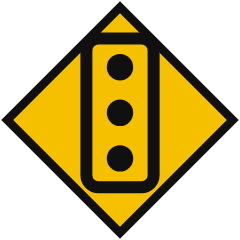
12. Why would this sign be installed on an approach?
Show answer
Answer B: Because the signal cannot be seen from far enough back for a driver to react in time
Advance notice of a signal is used where a crest, a curve, trees or a building keep the signal heads out of view until a driver is already too close to stop comfortably.
-
13. Why is a drive chain adjusted with too little slack a problem?
Show answer
Answer A: It strains the chain, the sprockets and the output shaft bearings
Suspension movement changes the distance between the sprockets, so a chain pulled tight at rest is stretched hard over bumps and wears everything it touches.
-
14. What protective gear should a passenger wear?
Show answer
Answer C: The same protective gear recommended for the operator
A passenger is exposed to the same crash forces, weather and road debris as the operator, so the same head, eye, hand, body and foot protection applies.
-
15. A motorcycle in your group develops a mechanical problem on a busy highway. What is the best response?
Show answer
Answer C: Signal the group off at the next exit or wide, safe pull off area
A narrow shoulder beside fast traffic is a dangerous place to gather, so the group moves on to a spot where every machine is well clear of the roadway.
-
16. A steady green arrow pointing left is displayed for your turning lane. What does it tell you?
Show answer
Answer D: The turn is protected because conflicting traffic is being held
A steady green arrow gives a protected movement in the direction shown, although you still yield to pedestrians and to any vehicle already inside the intersection.
-
17. Your left-turn lane shows a flashing yellow arrow. What does that indication allow?
Show answer
Answer B: A left turn after yielding to oncoming traffic and to pedestrians
A flashing yellow arrow marks a permissive left turn: the movement is allowed, but oncoming vehicles and pedestrians keep the right-of-way.
-
18. What does a sign reading Slower Traffic Keep Right require?
Show answer
Answer C: Traffic moving slower than the general flow must use the right-hand lane
The sign applies to any vehicle traveling below the speed of the traffic around it, which must keep right so faster vehicles can use the lanes to the left.
-
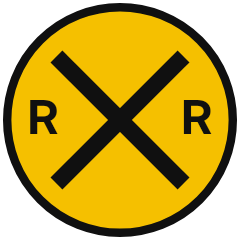
19. A driver sees this sign on a quiet road with no other traffic in either direction. What is the correct response?
Show answer
Answer C: Slow down, look and listen for a train, and be ready to stop
The sign gives advance notice of a highway-rail grade crossing, so the driver reduces speed, checks both directions along the tracks and keeps enough room to stop short of the rails.
-
20. Partway through a ride, a control starts to feel different from the way it normally feels. What is the right response?
Show answer
Answer B: Stop somewhere safe and find out what has changed before riding further
A change in feel is usually the first warning of a failing cable, a leaking brake or a loose fastener, and it is far cheaper to check at the roadside than to discover in traffic.
-
21. You are approaching the crest of a hill and cannot see the road beyond it. What should you do?
Show answer
Answer C: Slow down and keep well to the right
Beyond a blind crest there may be a stopped vehicle, a cyclist or an oncoming driver crossing the center line, so reduce speed and hold your own side.
-
22. How tight should the chin strap of a helmet be?
Show answer
Answer D: Snug under the jaw, tight enough that the helmet cannot be pulled off
A helmet only works if it stays on, so the strap must be fastened snugly under the jaw on every ride, including short ones.
-
23. A traffic signal is dark and you reach the intersection at the same moment as a vehicle on your right. Who goes first?
Show answer
Answer A: The vehicle on your right, as at any all-way stop
A dark signal is treated as an all-way stop, and the usual tie-breaker then applies: the vehicle on the right goes first.
-
24. You are already leaned over in a curve when you see loose gravel spread across the road ahead. What is the best response?
Show answer
Answer B: Slow gently, bring the bike more upright, and cross the gravel with steady throttle
A leaned tire has little grip left for braking or for loose stones. Reduce speed smoothly, get the motorcycle as upright as the curve allows, and hold a steady throttle across the gravel.
-
25. On a divided highway you see a median opening marked for authorized vehicles only. May you use it to turn around?
Show answer
Answer D: No, those openings are for emergency and maintenance vehicles
Official crossovers are reserved for emergency and highway maintenance use; turning there puts a slow vehicle across high-speed traffic.