
Alaska DMV Motorcycle Practice Test 46
- Questions25
- Correct to pass20
- Passing score80%
- Minimum age16 years
-
1. A yellow diamond on an exit ramp shows a truck tipping over onto two wheels. Which drivers does it concern most?
Show answer
Answer D: Those in tall vehicles carrying a high load
The truck rollover sign warns that the curve can overturn a vehicle with a high center of gravity, so such drivers must slow well below the normal ramp speed.
-
2. Traffic is heavy and you find yourself riding level with a car in the next lane. What is the problem with staying there?
Show answer
Answer B: You sit in the driver's blind spot, so a lane change could hit you
Motorcycles disappear easily in a blind spot, so adjust your speed to ride ahead of or behind the other vehicle instead of beside it.
-
3. In heavy fog at night on a rural two-lane road, which marking best helps a driver hold position?
Show answer
Answer C: The solid white line along the right edge
Steering by the right edge line keeps a driver clear of oncoming traffic, while watching the center line tends to pull the vehicle toward it.
-
4. What must you check about a load before riding away with it?
Show answer
Answer C: That it does not cover the tail light, the brake light or the signals
Luggage that hides the lights leaves drivers behind with no warning that the motorcycle is slowing or turning.
-
5. A squirrel darts into your path a short distance ahead. What is normally the safest response?
Show answer
Answer C: Hold your line, brake as much as is safe, and accept hitting a small animal
Swerving without space, or crashing while braking, hurts the rider far more than a small animal does, so stay in your lane and slow as much as traction allows.
-
6. Why can an oncoming vehicle that looks comfortably far away leave you far less room than you expect?
Show answer
Answer D: You and that vehicle close the gap at the sum of both your speeds
Two vehicles approaching at 55 mph each close the distance between them at about 110 mph, so the gap disappears in half the time you would expect.
-
7. An obstacle appears ahead and you can see there is no room left to stop before it. What should you do?
Show answer
Answer D: Swerve around it
Once the distance is too short to stop, changing direction is the only option left, and a motorcycle can change direction faster than it can stop.
-
8. The sun is low behind you and shining into the eyes of oncoming drivers. What should you do?
Show answer
Answer C: Turn on your headlights and expect oncoming drivers not to see you
Drivers facing the low sun may not see you at all, so make yourself as visible as possible and give way rather than insisting on your right of way.
-
9. Another vehicle is passing you on a two-lane road. What should you do with your speed?
Show answer
Answer A: Hold your speed or ease off slightly to shorten the pass
Speeding up strands the passing driver in the oncoming lane, while a steady speed or a slight lift lets the pass finish quickly and safely.
-
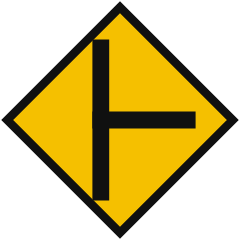
10. What condition does this sign warn a driver about?
Show answer
Answer B: Another road joins the road being traveled, from one side
It announces a side road entering the main roadway, so the driver should expect vehicles waiting to pull out and other vehicles slowing to turn in.
-
11. How does the crown of a road affect a turn made on it?
Show answer
Answer C: Turning toward the low side leaves less ground clearance for leaning
Leaning down the slope of the crown adds the slope to the lean angle, so the footrests and other parts reach the pavement sooner than they otherwise would.
-
12. You are driving through a neighborhood where several children are riding bicycles. What should you do?
Show answer
Answer C: Slow down and expect sudden, unpredictable moves
Young riders lack the judgment and the mirror habits of adults and may swerve or cross without looking, so lower speed is your only reliable margin.
-
13. A sign with a green background and a white legend normally provides
Show answer
Answer A: directions, distances and destinations
Green is the background color of the guide sign series, which names routes and destinations and gives the distance to them.
-
14. You are following closely behind a vehicle you intend to pass on a two-lane road. What should you do first?
Show answer
Answer D: Drop back to give yourself room to build speed before you pull out
From close behind you cannot see far enough ahead and you have no room to gather speed, so the pass takes longer and starts blind.
-
15. The blue signs mounted before a freeway interchange that carry the logos of individual businesses are
Show answer
Answer C: specific service signs, which show the brands available at that exit
Specific service signs, often called logo signs, list eligible businesses for categories such as gas, food, lodging, camping, attractions and 24-hour pharmacies at the upcoming interchange.
-
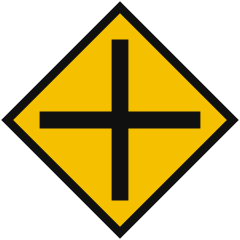
16. What should a driver expect a short distance beyond this sign?
Show answer
Answer C: Another road crossing the one being traveled
Traffic may enter or cross from either side at the intersection ahead, so the driver should ease off, cover the brake and check both approaches.
-
17. How is a wheel bearing checked during an inspection?
Show answer
Answer A: Raise the wheel clear of the ground and rock it side to side to feel for play
A worn bearing shows itself as side to side play in a raised wheel, and it may also feel rough or notchy when the wheel is spun.
-
18. How does eating a large meal before drinking affect impairment?
Show answer
Answer D: It slows absorption but the alcohol still reaches the blood and impairs you
Food delays how quickly alcohol enters the bloodstream, which can make the peak arrive later, but all of the alcohol is eventually absorbed.
-
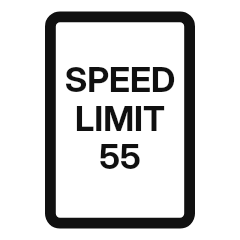
19. On a clear day with light traffic, a driver stays far below the maximum this sign sets. What can that cause?
Show answer
Answer B: Obstruction of the normal flow of traffic, which is prohibited in itself
Driving so slowly that other traffic is impeded is an offense in its own right when nothing about safety, weather or the road calls for it.
-
20. What do flashing yellow lights on a school bus mean?
Show answer
Answer A: The bus is about to stop to load or unload, so prepare to stop
The amber lights are the warning phase that comes before the red lights and the stop arm, so drivers should slow down and get ready to stop.
-
21. When may you stop on the shoulder of a freeway?
Show answer
Answer A: Only in an emergency, moving completely off the travel lanes and switching on your hazard lights
The freeway shoulder is reserved for emergencies and for disabled vehicles, and a vehicle stopped there must be clear of the travel lanes with hazard lights on.
-
22. Is it acceptable to drive far below the flow of traffic on an open highway?
Show answer
Answer B: No, driving too slowly can obstruct traffic and create a hazard
Traffic that is much slower than the surrounding flow forces other drivers into sudden braking and unnecessary passing maneuvers, and impeding traffic is itself a violation.
-
23. You are descending a long steep grade with a loaded truck close behind you. What should you do?
Show answer
Answer A: Hold a steady speed and let it pass when it can
Gravity pushes a loaded truck downhill and it cannot slow quickly, so give it a predictable speed and room to get by rather than braking in front of it.
-
24. A large truck ahead of you in a roundabout is using part of both lanes as it goes around. What is the correct response?
Show answer
Answer B: Stay back and give it room until it leaves the roundabout
Long vehicles need extra width to get around the central island, so drivers behind must hold back rather than share the space beside them.
-
25. What visual acuity does Alaska require before a license or permit is issued?
Show answer
Answer B: At least 20/40 in each eye or with both eyes together
Alaska requires at least 20/40 vision in each eye or with both eyes together, and a driver who needs corrective lenses to reach the standard must wear them while driving.