
Alaska DMV Motorcycle Practice Test 27
- Questions25
- Correct to pass20
- Passing score80%
- Minimum age16 years
-
1. You arrive at an intersection where the traffic signal is completely dark because of a power failure. How should you proceed?
Show answer
Answer C: Treat the intersection as an all-way stop
When a signal shows no indication at all, drivers on every approach must stop and then take turns, exactly as at an all-way stop.
-
2. Why must a rider turn the head and look before changing lanes?
Show answer
Answer A: Mirrors leave blind spots that only a direct look can cover
Motorcycles have blind spots just as cars do, and a vehicle hidden in one will not appear in the mirrors at all.
-
3. Where in the United States may a motorcycle ride between lanes of traffic?
Show answer
Answer C: Only where a state has specifically authorized it
Riding between lanes is prohibited in most states and permitted only where a state law expressly allows it, so a rider must know the rule for the state being ridden in.
-
4. You have started to pass and you see the no-passing zone beginning ahead. What should you do?
Show answer
Answer D: Ease off, drop back and return to your own lane
A pass must be completed before the no-passing zone starts. If it will not fit, abandon it and slot back in behind.
-
5. Rain is falling and the outside temperature reads close to 32 degrees Fahrenheit. Why is that dangerous?
Show answer
Answer A: The rain can freeze on contact and glaze the road with ice
Near freezing, rain landing on cold pavement can turn to a glaze of ice almost at once, so a road that looks merely wet may have no grip at all.
-
6. What does the Alaska DMV do when a driver reaches half of the points needed for a suspension?
Show answer
Answer B: It sends a warning letter about correcting the driving behavior
Alaska sends a warning letter when a violator reaches the halfway mark toward a point suspension, advising the driver to take steps to correct their driving behavior.
-
7. The street you are turning right onto has a bike lane along its right edge. Where should your vehicle end up?
Show answer
Answer B: In the first traffic lane to the left of the bike lane
A bike lane is not a travel lane for motor vehicles, so the nearest lane you may finish a right turn in is the first general traffic lane beside it.
-
8. How should tire pressure be checked and set?
Show answer
Answer B: When the tires are cold, set to the pressure specified by the vehicle manufacturer
Driving heats the air and raises the reading, and the sidewall number is a maximum rather than a recommendation, so check cold and use the figure on the vehicle placard or in the owner's manual.
-
9. A pedestrian steps off the curb in the middle of a block where there is no crosswalk at all. What is the legal position?
Show answer
Answer A: They must yield to you, but you must still avoid a crash
A pedestrian crossing away from a crosswalk yields to vehicles, yet every driver still has a duty to use care and avoid hitting a person.
-
10. A pedestrian is crossing a wide four-lane street and has reached the lanes on the far side. When may you go on?
Show answer
Answer C: Only after the person has finished crossing the roadway
Waiting until the pedestrian has finished crossing is correct in every state and removes any doubt about how much clearance your state demands.
-
11. The rider behind you is closing right up on your machine and crowding you. What is the best response?
Show answer
Answer D: Let them go past and take a position behind them instead
Speeding up to escape a rider who is following too closely usually brings them with you, while letting them past removes the pressure entirely.
-
12. Why are motorcycles so often missed by other drivers?
Show answer
Answer C: Their narrow shape is easily hidden in traffic
A motorcycle presents a narrow outline that disappears behind pillars, mirrors and other vehicles, and it is harder to judge its speed and distance.
-
13. A black and white regulatory sign facing traffic at a divided section reads KEEP LEFT. What does it require?
Show answer
Answer D: Passing the island or obstruction on its left side
Keep Left is posted at an island or obstruction that traffic must pass on the left, which is the opposite of the far more common Keep Right situation.
-
14. What does the last step of T-CLOCS, Stands, ask a rider to check?
Show answer
Answer D: That the stands are not bent and that their springs hold them up
A bent stand or a weak spring can let the stand fall while riding, so both the sidestand and the centerstand are checked for damage and spring tension.
-
15. A driver passes this sign on an open road. Over what stretch does the figure it sets stay in force?
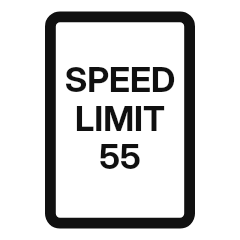
Show answer
Answer A: From the sign onward, in every lane, until another sign sets a different figure
The figure governs the road from the sign onward and binds every lane, and it stays in force until a later sign sets a different one.
-
16. You are stopped in a shared through and right-turn lane with your right signal on, and a bicyclist rides up along your right side. What should you do?
Show answer
Answer A: Let the bicyclist clear the intersection or move ahead before you turn
A cyclist alongside your right side is in the path your turn will sweep across, so wait until that space is clear before turning.
-
17. It is very hot and a rider is tempted to take off the riding jacket. Why can that make the heat worse?
Show answer
Answer C: A bare arm in hot moving air loses fluid fast and burns in the sun
In hot, dry air a covering layer slows the evaporation of sweat and blocks the sun, so ventilated gear can keep a rider cooler and better hydrated than bare skin.
-
18. A large electronic advertising sign beside the road catches your eye. What should you do?
Show answer
Answer A: Glance briefly and return your eyes to the road
Bright changing displays are designed to hold attention, so treat them like any roadside object and give them no more than a brief glance.
-
19. At an intersection the signal flashes red toward you and flashes yellow toward the cross street. Who must yield?
Show answer
Answer D: You must, because the flashing red faces your road
A flashing red means stop and yield like a stop sign, while a flashing yellow lets the other road proceed with caution.
-
20. Where should a rider with a disabled motorcycle try to stop?
Show answer
Answer D: Well clear of the traffic lanes, off the shoulder where there is room
Getting completely away from moving traffic protects the stopped rider and anyone helping, and a shoulder alone is not a safe place to work on a machine.
-
21. An entrance ramp joins a highway just before an exit ramp leaves it. What should you expect in that short section?
Show answer
Answer D: Vehicles crossing paths as some enter and others leave
In a weaving section entering traffic moves left while exiting traffic moves right over the same short stretch, so lane changes there need extra room and extra care.
-
22. Where is a road work ahead sign placed?
Show answer
Answer B: In advance of the work space or detour, so drivers are warned before reaching it
Advance warning signs are placed upstream of the work space or detour so that drivers have time to slow down and change lanes before reaching the activity.
-
23. On a rural two-lane road you pass small blue signs, each naming one business with an arrow and a distance. What are they?
Show answer
Answer D: Tourist-oriented directional signs for traveler businesses
Tourist-oriented directional signs carry a white legend on blue and are used on rural conventional roads to guide travelers to eligible businesses.
-
24. On a two-lane road, a solid yellow line runs on your side of the center while a broken yellow line runs on the other side. What does this mean?
Show answer
Answer D: You may not pass, although oncoming drivers may
Passing restrictions are read from the line closest to your own lane, so a solid yellow line on your side creates a no-passing zone for you alone.
-
25. Why should the leader of a group check the mirrors regularly?
Show answer
Answer B: To see whether the group is still together and adjust the pace if not
The leader is the only rider who can see the whole formation, and slowing slightly is the usual way to gather a group that has strung out.