
Alaska DMV Permit Practice Test 61
- Questions20
- Correct to pass16
- Passing score80%
- Minimum age14 years
-
1. A small plate under a stop sign reads CROSS TRAFFIC DOES NOT STOP. What is it telling you?
Show answer
Answer D: Traffic on the cross street is not required to stop at all
The plate warns that the other road is uncontrolled, so you must wait for a gap instead of expecting anyone to take turns with you.
-
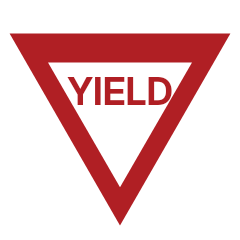
2. Apart from other vehicles, who else must a driver let go first at this sign?
Show answer
Answer A: Pedestrians and cyclists already in or entering the crossing
The duty to give way covers every road user who has the right of way at that point, including people walking or cycling across the driver's path.
-
3. Which part of the space around your vehicle can you control best?
Show answer
Answer A: The space ahead of you
You choose your own following distance, so the gap in front is the space you truly control and the one that gives you time to react.
-
4. What is a good rule for any task you want to do inside the vehicle?
Show answer
Answer D: If it needs more than a moment, do it stopped
A glance of a second or two is manageable, but any task that runs longer belongs to a stopped vehicle, because the road does not pause while you do it.
-
5. You pass into a work zone with a reduced speed limit but you see no workers. What speed applies?
Show answer
Answer D: The posted work zone limit, whether or not workers are present
A posted work zone speed limit is a regulatory limit in force at all times, and narrow lanes and uneven surfaces remain dangerous when nobody is working.
-
6. On a two-way street, where and how should you park at the curb?
Show answer
Answer C: On the right side, facing the way traffic moves
On a two-way street you must park on the right, headed in the direction of travel; parking facing traffic is prohibited.
-
7. You must cross a stretch of water lying across the road that you know is shallow. What is the right technique?
Show answer
Answer A: Slow down before you reach it and cross steadily in a low gear
Slow before the water, then keep a steady low speed so you do not throw water over the engine or lose steering. Test the brakes gently once you are through.
-
8. A yellow diamond shows an arrow that doubles back on itself. What kind of curve lies ahead?
Show answer
Answer C: A turn of 135 degrees or more, nearly doubling back
The hairpin curve sign is used where the road changes direction by 135 degrees or more, and it is normally backed up by chevrons or a large arrow through the bend.
-
9. You are turning left from a two-way street onto another two-way street. Where should you begin and end the turn?
Show answer
Answer B: Begin in the lane just right of the center line and finish just right of the center line of the new street
You approach a left turn from the lane closest to the center line and enter the new roadway just to the right of its center line, which keeps you clear of oncoming traffic.
-
10. You realize at the last moment that you have passed the street where you meant to turn. What should you do?
Show answer
Answer D: Keep going and turn around where it is safe and legal
A missed turn is a minor inconvenience; braking suddenly, backing up or turning across traffic to recover it causes crashes.
-
11. Where is a U-turn most clearly unsafe and generally prohibited?
Show answer
Answer D: On a curve or near a hill crest, where other drivers cannot see you
U-turns are barred where approaching drivers cannot see you in time, such as on a curve or near the top of a hill.
-
12. What does Alaska law provide for a driver under 21 who operates a motor vehicle after consuming alcohol?
Show answer
Answer C: The Division of Motor Vehicles must revoke driving privileges administratively
Alaska requires administrative revocation for minors under 21 who operate a vehicle after consuming alcohol or who refuse chemical testing, and the court must also order community service or a fine of up to 1,000 dollars.
-
13. How far ahead should you normally be looking while driving?
Show answer
Answer D: About 12 to 15 seconds of travel ahead
Looking that far ahead, roughly a block in town and much farther on a highway, gives you time to see a problem developing and adjust before it becomes an emergency.
-
14. How does driving on overinflated tires affect the vehicle?
Show answer
Answer D: It gives a harsher ride and a smaller contact patch
An overinflated tire bulges in the middle, so less rubber touches the road, grip suffers and the ride becomes hard. The center of the tread wears first.
-
15. A city transit bus ahead of you has stopped at the curb with its passenger door open. What does the law require of you?
Show answer
Answer D: Nothing special, but pass slowly and watch for people
The mandatory stop applies to a school bus showing red flashing lights, not to a transit bus, though a careful driver still slows for crossing passengers.
-
16. Your car has side curtain airbags. What should you avoid doing?
Show answer
Answer B: Resting your head against the window or the door pillar
A side airbag deploys from the pillar or roof rail, so a head leaning against that area is directly in its path.
-
17. You find yourself in a lane that must turn, you wanted to go straight, and you cannot change lanes safely. What should you do?
Show answer
Answer D: Make the required turn and find another route
Going straight from a mandatory turn lane surprises everyone around you, while a wrong turn costs only a few extra minutes.
-
18. How does heavy cargo on a roof rack change the way a vehicle handles?
Show answer
Answer D: It raises the center of gravity, so the vehicle tips more in turns and needs gentler steering
Weight carried high makes the vehicle lean more and roll over more easily, and extra weight lengthens stopping distance. Drive slower and steer smoothly with a loaded roof.
-
19. What happens when alcohol is combined with another drug that also affects the nervous system?
Show answer
Answer B: Impairment is often far greater than either one alone would produce
Combined substances can multiply each other's effects, producing impairment well beyond what a driver would expect from either one taken separately.
-
20. You and an oncoming driver are both turning left at the same intersection. What is the usual rule?
Show answer
Answer D: Both turn in front of each other unless markings show otherwise
The normal practice is to pass driver side to driver side, turning in front of one another, unless pavement markings or signs direct a different path.