
Alaska DMV Permit Practice Test 58
- Questions20
- Correct to pass16
- Passing score80%
- Minimum age14 years
-
1. Traffic has built up behind you while you wait for a gap to turn left. How should that affect your decision?
Show answer
Answer C: It should not change it; wait for a gap that is genuinely safe
Pressure from behind does not make a small gap bigger, and rushing a left turn across traffic is a common cause of serious crashes.
-
2. A tractor-trailer is backing slowly across the roadway to enter a loading dock. What should you do?
Show answer
Answer C: Stop and wait until the truck has finished the maneuver
A backing truck driver has a very limited view and the trailer can swing unexpectedly. Trying to squeeze past in either direction risks being crushed.
-
3. You are waiting to enter a two-lane roundabout and traffic is circulating in both lanes. What must you do?
Show answer
Answer A: Yield to traffic in both circulating lanes before you enter
Every entry to a roundabout is a yield point, and at a two-lane roundabout that means giving way to vehicles in either circulating lane.
-
4. Your light turns green while a pedestrian who started on the walk signal is still crossing in front of you. What must you do?
Show answer
Answer D: Let them finish crossing the road before you move off on your green light
A pedestrian who entered the crosswalk lawfully keeps the right of way until they reach the other side, whatever the signal now shows.
-
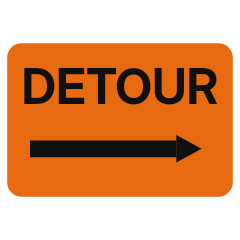
5. Which of these is true of the roadway a driver is being sent onto here?
Show answer
Answer D: Its own signs, signals and speed limits govern for the whole way around
The alternate route is an ordinary public road, so every control posted on it governs as usual; being sent that way grants no extra priority and no relief from the limits in force there.
-
6. What is the best way to handle the radio, the music player and the climate controls on a trip?
Show answer
Answer B: Set them before you start driving and let a passenger handle changes
Fiddling with controls takes eyes and hands off the driving task. Setting them before you move and letting a passenger make later changes removes the distraction entirely.
-
7. A small yellow plaque showing a speed number below a curve warning sign gives
Show answer
Answer C: the speed recommended for the condition being warned about
The advisory speed plaque belongs to the warning series and states the speed judged safe for the condition ahead under good circumstances, not a regulatory limit.
-
8. A sign shows a lane joining from the right with no merge required. What does that mean?
Show answer
Answer B: The joining traffic gets its own new lane, so nobody has to merge
An added lane means the roadway gains a lane at that point, so entering vehicles have somewhere to go without anyone changing lanes.
-
9. You are approaching the entry of a modern roundabout. Who must you yield to?
Show answer
Answer C: Traffic already circulating in the roundabout, which approaches from your left
Traffic in a United States roundabout circulates counterclockwise, so drivers entering must look left and yield to vehicles already in the circulating roadway.
-
10. You are pulling out of a farm entrance onto a rural highway. What is your obligation?
Show answer
Answer C: Yield to every vehicle already on the highway before you enter the roadway
A driver entering a highway from a private road or driveway yields to every vehicle already on the highway.
-
11. A sign at the approach to a bridge reads WEIGHT LIMIT 10 TONS. What does the figure set?
Show answer
Answer B: The heaviest vehicle the bridge may legally carry
A weight limit sign is a regulation based on what the structure can bear, and it applies to the loaded weight of the whole vehicle.
-
12. You are waiting to pull out of a driveway when a bicyclist comes along the bike lane in front of you. What must you do?
Show answer
Answer D: Wait until the bicyclist has gone past
A driver leaving a driveway yields to everything already on the road, and a bike lane is part of the roadway.
-
13. A small plaque mounted under this sign shows a numeral such as 2 or 3. What does that numeral report?

Show answer
Answer A: How many sets of tracks the crossing carries
The plaque states the number of tracks at that location, which is a warning that a second train may be running on another track behind the first.
-
14. Why should you not leave the engine running when you walk away from your vehicle?
Show answer
Answer C: Because the vehicle can be stolen or can move on its own
An unattended running vehicle is an easy theft and, if the transmission slips or is knocked out of park, it can roll away with nobody at the wheel.
-
15. Why is a sign reading BRIDGE ICES BEFORE ROAD worth heeding even when the road itself is merely wet?
Show answer
Answer C: Cold air passes under a bridge as well as over it
A bridge deck loses heat from below as well as above, so it can be frozen while the road on either side of it is only wet.
-
16. The blue signs mounted before a freeway interchange that carry the logos of individual businesses are
Show answer
Answer C: specific service signs, which show the brands available at that exit
Specific service signs, often called logo signs, list eligible businesses for categories such as gas, food, lodging, camping, attractions and 24-hour pharmacies at the upcoming interchange.
-
17. You are about to drive a rental car that you have never driven before. What should you do?
Show answer
Answer A: Adjust the seat and the mirrors and find the controls before moving off
Hunting for the wipers or the lights in traffic is a distraction, so learn the layout while the vehicle is stopped.
-
18. A child has outgrown the rear-facing seat. What comes next?
Show answer
Answer D: A forward-facing seat with a harness, used up to its own stated limits
The stages run rear facing, then forward facing with a harness, then a booster, then the adult belt alone.
-
19. You are passing a crash on the other side of a divided highway. What should you do?
Show answer
Answer D: Keep your eyes on your own lane and the traffic around you
Staring at a crash scene, often called rubbernecking, causes sudden slowing and secondary collisions. Your attention belongs on the traffic in front of you.
-
20. How does being tired change your total stopping distance?
Show answer
Answer A: It lengthens it, because you take longer to notice and react
Fatigue stretches perception and reaction time, and every extra fraction of a second is added distance before the brakes even begin to work.