
Alaska DMV Permit Practice Test 41
- Questions20
- Correct to pass16
- Passing score80%
- Minimum age14 years
-
1. What does a booster seat do for a child?
Show answer
Answer B: It lifts the child so that the adult belt crosses hips and shoulder
A booster raises the child so the adult belt lies on the strong parts of the body instead of the neck and the abdomen.
-
2. The school bus stop ahead sign is installed where
Show answer
Answer C: a school bus stop cannot be seen from far enough away by approaching drivers
This school warning sign is used in advance of a bus stop that lacks adequate sight distance and cannot be relocated, so drivers are warned before the stopped bus comes into view.
-
3. Every signal head at an intersection is flashing red in all directions. How should you treat the intersection?
Show answer
Answer C: As an all-way stop, stopping and then going in turn
Red flashing in every direction means each approach must stop, so the intersection works exactly like an all-way stop.
-
4. Your vehicle has a blind spot warning light in the door mirror. What should that mean for your habits?
Show answer
Answer B: You still check the blind spot yourself, because the system can miss a rider
Blind spot systems are an aid, not a substitute, and a motorcycle or a bicycle can be missed or arrive faster than the sensor expects.
-
5. You are on a city street with two lanes in your direction, cars parked along the curb and driveways every few yards. Which lane is usually safer?
Show answer
Answer B: The lane farther from the curb, away from opening doors and vehicles pulling out
Most of the hazards on such a street come from the curb side, so the inside lane gives you more space and more time to react.
-
6. Which passengers may an Alaska provisional license holder carry with no qualifying adult in the vehicle?
Show answer
Answer B: Siblings
The Alaska provisional passenger restriction makes an explicit exception for the young driver siblings, while other young passengers require a parent, guardian or licensed person at least 21 to be present.
-
7. A yellow diamond showing the silhouette of a deer warns that
Show answer
Answer D: large animals may cross the road in that area
The sign marks a stretch where animals are known to cross, so drivers should reduce speed and scan both roadsides, especially around dawn and dusk.
-
8. You are already inside a roundabout when an emergency vehicle approaches with lights and siren. What should you do?
Show answer
Answer B: Continue to your exit, leave the roundabout, then pull over and stop
Stopping inside a roundabout blocks the circulating roadway, so you should exit first and then pull over clear of the intersection.
-
9. A traffic signal is displaying a flashing red light. How must you treat it?
Show answer
Answer D: Stop completely, then proceed when the way is clear
A flashing red carries the same meaning as a stop sign: come to a full stop, then go only when it is safe.
-
10. Besides its height, what else matters about a head restraint?
Show answer
Answer C: That it is close to the back of the head, and not far behind it
A restraint that sits far behind the head lets the head snap back before it is caught, so a small gap is important.
-
11. You are stopped at a stop sign on a two-way stop intersection and the cross street has no stop signs at all. What does that mean for you?
Show answer
Answer A: You yield to all cross traffic no matter how long that takes
At a two-way stop only your direction is controlled, so there is no taking turns; you wait for a gap big enough to enter safely.
-
12. No plaque stating days or hours accompanies this sign at the intersection. When does the restriction apply?
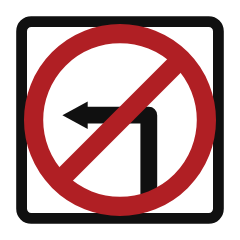
Show answer
Answer D: At all times, since nothing limits it to particular periods
A regulatory restriction runs continuously unless a supplemental plaque states the days or hours during which it applies.
-
13. Where is this sign installed in relation to the hazard it announces?
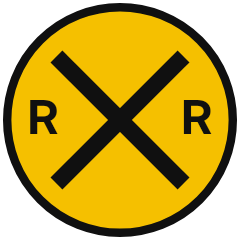
Show answer
Answer A: Far enough before the hazard that a driver can slow down and stop short of it
This is an advance warning sign, placed on the approach so a driver has time to react before reaching a crossing that a curve or a crest may be hiding.
-
14. A center lane is bordered by a solid yellow line on the outside and a broken yellow line on the inside, with left-turn arrows painted in it. How may you use that lane?
Show answer
Answer A: Only to make a left turn or to prepare for one from either direction
That marking identifies a two-way left turn lane, which may only be used for left turns or to prepare for a left turn and never for travel or passing.
-
15. A rear tire blows out on the highway. How does the vehicle usually behave?
Show answer
Answer C: The back end weaves or fishtails from side to side
A rear failure shows up as the tail wandering rather than a pull on the steering, so hold the wheel straight and let the speed drop gradually.
-
16. Where is the safest place for children under 13 to ride?
Show answer
Answer C: In the back seat
The back seat keeps children away from the force of a deploying front air bag and is farther from the most common impact area, which is why it is recommended through at least age 12.
-
17. Where is a three-point turn most clearly a bad idea?
Show answer
Answer A: On a busy street near a curve, where approaching drivers cannot see you
The maneuver leaves you blocking the road for several seconds, so it needs light traffic and a long clear view; a blind curve gives neither.
-
18. A grade crossing is marked only with a crossbuck and has no lights or gates. What does the crossbuck require of you?
Show answer
Answer C: Yield to rail traffic and cross only when no train is approaching
The crossbuck requires road users to yield the right-of-way to rail traffic, so you must look and listen and be ready to stop.
-
19. You are approaching a yield sign and no other vehicle is anywhere in sight. What does the sign require?
Show answer
Answer A: Slow down and be ready to stop, but stop only if needed
A yield sign requires you to slow and give way, and to stop only when traffic or pedestrians make stopping necessary.
-
20. You are driving on a rural road with no sidewalk. Where should you expect to meet pedestrians?
Show answer
Answer A: Walking toward you on your side of the road
Where there is no sidewalk, pedestrians are taught to walk facing traffic, so they appear on your side of the road coming toward you.