
Alaska DMV Permit Practice Test 25
- Questions20
- Correct to pass16
- Passing score80%
- Minimum age14 years
-
1. What should you do before you back out of your own driveway at home?
Show answer
Answer A: Walk around the vehicle and check behind it for children or objects
A small child, a bicycle or a toy can sit entirely inside the blind area behind a vehicle, and a walk-around is the only way to be sure it is clear.
-
2. Apart from giving you room to stop, what else does a longer following gap do for you?
Show answer
Answer D: It widens your view of the road and the traffic ahead
Sitting further back lets you see past and around the vehicle in front, so hazards reach your eyes seconds earlier.
-
3. You are driving on a road covered with a layer of wet fallen leaves. What should you expect?
Show answer
Answer B: As little grip as on ice, plus hidden markings and hidden holes
Wet leaves are as slippery as ice and they hide the lane lines and any potholes underneath, so slow well before curves and stops.
-
4. You have a green light and are turning right while people are crossing the street you want to enter. Who goes first?
Show answer
Answer B: The pedestrians, and you wait until they are clear of your path
A green light permits the turn but does not remove the duty to yield to pedestrians already crossing the street you are turning into.
-
5. A lane is marked with a large white bicycle symbol and chevrons, but there is no separate bicycle lane. What does it mean?
Show answer
Answer A: Bicyclists may use the whole lane, so follow or pass with care
A shared lane marking shows that bicyclists and drivers use the same lane and positions riders away from parked car doors, so passing means changing lanes.
-
6. A sign on a divided highway reads Keep Right Except to Pass. What does it require of you?
Show answer
Answer A: Use the left lane only to overtake, then return to a lane on the right
The left lane on such a highway is reserved for overtaking, so a driver who has finished a pass must move back to the right.
-
7. You are backing a trailer and want its rear to move to the left. Which way should you turn the steering wheel?
Show answer
Answer A: Move the bottom of the wheel to the left, which turns the top to the right
A trailer moves opposite to the tow vehicle's steering when backing. Holding the wheel at the bottom and moving your hand in the direction you want the trailer to go makes this easier.
-
8. Traffic is entering the freeway from a ramp ahead of you and you are in the right lane. What should you do?
Show answer
Answer C: Move to another lane if it is safe, or adjust your speed to make room
Merging drivers may have little room to adjust. Helping them in by changing lanes or easing your speed prevents conflicts even though they must legally yield to you.
-
9. On a long, straight highway you feel your attention fading. What helps you stay alert?
Show answer
Answer A: Keep your eyes moving, scan mirrors and signs, and take regular breaks
Staring at one point brings on highway hypnosis. Active scanning keeps the mind engaged, and a break every couple of hours restores alertness.
-
10. A warning sign showing two children on a see-saw is posted beside a residential street. What does it mean?
Show answer
Answer D: A play area lies beside the road and children may run out
The playground sign warns that children are present next to the roadway and may enter it without looking, so drivers should cover the brake and slow down.
-
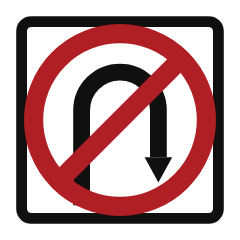
11. Why is this restriction used so often on a divided road just before a crest or a bend?
Show answer
Answer A: Because a vehicle turning across the median there stays hidden from approaching drivers until it is too late
The maneuver needs a long gap and good visibility, and where sight distance is short an approaching driver has no time to react to a vehicle turning across the road.
-
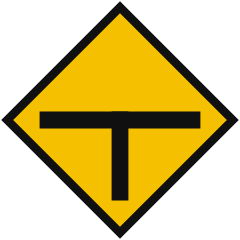
12. What must a driver be prepared to do at the point this sign refers to?
Show answer
Answer D: Turn left or right, because the road being traveled ends there
The road ends at another roadway, so the driver must slow, give way to traffic on the through road and turn in one direction or the other.
-
13. What is meant by keeping a space cushion?
Show answer
Answer C: Keeping open space on all sides of your vehicle so you always have somewhere to go
Open space ahead, behind and to the sides gives you time to react and an escape path when a hazard appears, which is the core idea of defensive driving.
-
14. What should you do about snow and ice on your vehicle before driving?
Show answer
Answer C: Clear all glass, mirrors and lights, and the roof and hood as well
Snow left on the roof or hood slides onto your windshield when you brake and blows into the path of drivers behind you, and covered lights make your vehicle hard to see.
-
15. A highway lane is marked with a large white diamond and signed as a high-occupancy vehicle lane. Who may use it?
Show answer
Answer B: Only vehicles carrying at least the number of occupants shown on the sign, during the posted hours
The diamond marking identifies a preferential lane whose occupancy requirement and hours of operation are stated on the accompanying signs.
-
16. A line of short dashes set closer together than an ordinary lane line runs beside your lane where a ramp leaves the highway. What does a dotted line of that kind convey?
Show answer
Answer A: A warning that the lane is about to change function
Dotted lines give guidance or warning about a downstream change, such as a lane that becomes an exit only lane or a lane line carried across an intersection.
-
17. During the reversing part of a three-point turn, where should you be looking?
Show answer
Answer C: Over your shoulder through the rear window, glancing both ways
You look through the rear window in the direction the car is moving, checking both ways for traffic and people, because mirrors and cameras leave blind areas.
-
18. What happens to an Alaska driving record when the rider of a bicycle is convicted of a traffic violation?
Show answer
Answer A: No points are assessed for a violation committed on a bicycle
Alaska law provides that no points are assessed for traffic violations committed while using a bicycle, although cyclists must still obey the rules of the road.
-
19. You have stopped on the shoulder of a busy freeway with a flat tire that you cannot change safely. Where should you and your passengers wait?
Show answer
Answer A: Well away from the traffic side, behind a barrier or up the bank if there is one
People struck on the shoulder are a common cause of roadside deaths, so wait away from the traffic side and behind any barrier.
-
20. A yellow sign shows a truck on a slope with the legend 7 PERCENT GRADE. What should a driver of a heavy vehicle do?
Show answer
Answer A: Select a lower gear before starting down
The percentage shows how steep the descent is, and choosing a low gear at the top lets the engine hold the vehicle back instead of the brakes overheating.